The Soapbox Rant
May 18th 2026

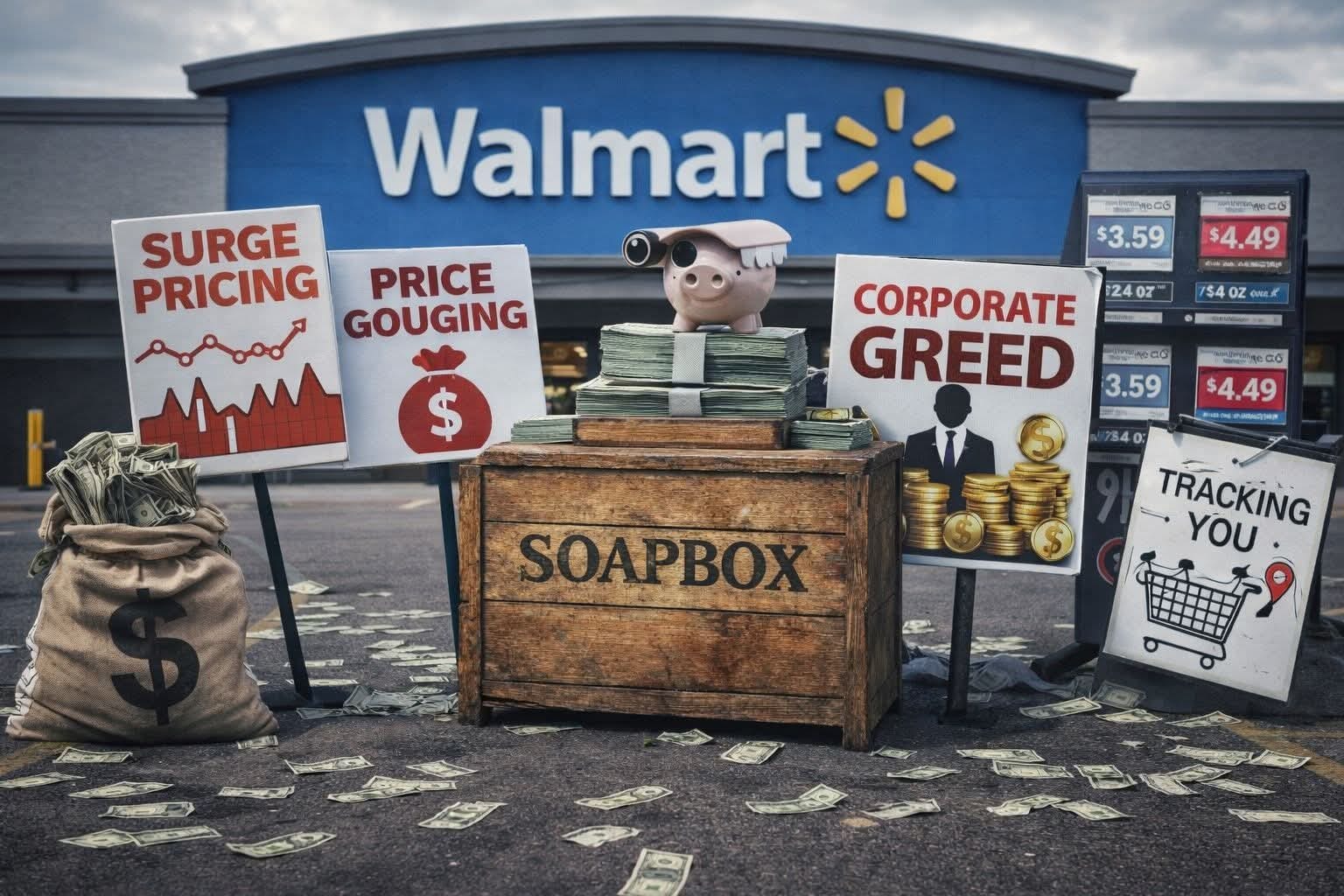
All right, drag the splintered soapbox out of the discount aisle and plant it right between the rollback sign and the self-checkout machine that already thinks I am stealing parsley because I scanned it too slowly. I am climbing onto this wooden crate with the spiritual exhaustion of a man who has watched corporations take every scummy tactic in the playbook, run it through a branding department, and hand it back to the public with a smile and a press release about innovation. Because that is what this is. It is not innovation in any morally meaningful sense. It is the same old greed wearing a fresh silicone mask and talking like a consultant who says things like consumer optimization with a straight face. When a company patents systems for dynamically and automatically updating prices, and then also builds the store infrastructure to change those prices almost instantly, the public is not irrational for noticing the giant blinking sign that says, “Well this sure looks like the assembly of a future headache.” Walmart has said these patents are not about surge pricing, and fine, that is their official line. I am capable of reading a denial without immediately swallowing it whole like a gull at a landfill. What matters to me is that companies do not spend time and money patenting capabilities they find morally repulsive and never intend to use in any meaningful way. They patent optionality, they build leverage, and they create tools first so the ethics department can arrive later on a scooter after the damage is already done.
This is where the corporate euphemism factory starts puffing white smoke like a crooked pope election for business school ghouls. They do not call it price gouging. They do not call it squeezing people for the maximum possible blood volume before the customer becomes medically translucent. They call it dynamic pricing, algorithmic pricing, intelligent markdowns, demand forecasting, and other phrases engineered to sound like a harmless spreadsheet took a night class. But if the practical outcome is that essential goods become more expensive precisely when people need them most, then congratulations, you have reached the moral destination even if you changed trains halfway there. A plane ticket is one thing. I hate it there too, but that rotten animal escaped the barn years ago and now it is running around in first class drinking mini bottles of whiskey. Groceries are different. Food is different. Household basics are different. When the thing being optimized is not a luxury but the cost of eating, feeding a child, or buying cold medicine, the ethical stakes jump through the roof and land directly on the public. That is why Maryland’s governor has already backed legislation aimed at banning dynamic pricing and surveillance-based individualized pricing in grocery stores, because lawmakers can see exactly where this road wants to go even if every corporation insists it is merely walking near the on-ramp by coincidence.
And let us pause for a moment to appreciate the breathtaking audacity of pretending shoppers are overreacting when the physical machinery for rapid price changes is already being installed. Walmart announced digital shelf labels at 2,300 stores by 2026, and Reuters reported those labels can update prices on more than 120,000 items within minutes instead of taking workers roughly two days to swap paper tags manually. I would love to know what kind of innocent saintly explanation I am supposed to accept here beyond the obvious one that this makes changing prices faster, easier, cheaper, and more scalable. Companies do not spend heavily to make a thing possible because they are deeply committed to never enjoying the benefits of that thing. They do it because friction is the enemy of exploitation. The slower a price change is, the more human beings have to touch it, think about it, justify it, and explain it. The faster a price change is, the more it becomes a quiet background function of software, and the less the average customer can see the hand on the lever. Suddenly the greasy fingerprints disappear and all that remains is a very polished statement about efficiency. Funny how efficiency always seems to arrive with its hand already in someone else’s pocket.
Walmart’s defenders will immediately say the patents are narrower than the panic, and to be fair, that part is not entirely wrong. One patent granted in January 2026 covers a system and method for dynamically and automatically updating item prices on an e-commerce platform, with the patent materials describing markdown generation using demand and price-elasticity data. Reporting this week also says Walmart secured another patent related to using machine learning to forecast demand and recommend prices, while the company told the Financial Times those patents are unrelated to dynamic pricing and that it does not participate in surge pricing. Fine. I can grant all of that without surrendering the basic point. Because if you hand a corporation a machine that predicts demand, estimates how much customers will tolerate, recommends a price, and can eventually be connected to infrastructure that updates shelves at scale, then the corporate temptation is not some philosophical abstraction floating in the distance like a cloud shaped like Milton Friedman. It is right there in the wiring diagram. The issue is not whether Walmart has publicly announced the ugliest version yet. The issue is that the ingredients are sitting on the kitchen counter and the stove is already warm.
This is also not just a Walmart story, which is why the larger ethical dilemma matters so much. Reuters recently reported growing state scrutiny of dynamic and algorithmic pricing, especially when personal data could be used for individualized pricing, while the FTC has been studying these practices and states like California and New York have moved more aggressively on enforcement or disclosure. That matters because the danger is not merely that a shelf tag changes more often. The deeper rot is surveillance pricing, where your browsing history, loyalty data, location, shopping behavior, and whatever other digital crumbs you shed like a stressed-out trail mix become ammunition in somebody else’s revenue model. It is one thing for a store to say bananas cost a certain amount today. It is another thing entirely for a system to decide that bananas cost more for you, right now, because your behavior suggests you are tired, urgent, loyal, desperate, distracted, affluent, captive, or simply too busy to comparison shop. At that point, commerce stops being commerce and starts feeling like a casino run by a therapist with access to your metadata. No, thank you. I already live in late capitalism. I do not need it wearing a fake mustache and asking for my zip code again.
And yes, this brings me right back to Walmart’s old business model, because none of this exists in some moral vacuum where the company suddenly deserves the benefit of every doubt. The Government Accountability Office found that millions of low-wage workers rely on Medicaid and SNAP, and in data gathered across multiple state agencies Walmart appeared among the top employers of beneficiaries. A new 2026 Institute for Policy Studies analysis says Walmart’s 2024 median pay was $29,469, below income thresholds that can qualify a family of three for Medicaid in most states and below the SNAP threshold cited in that report. Reuters summarized the broader finding this month as a kind of corporate welfare problem, where many large low-wage firms pay so little that workers remain eligible for public benefits while CEOs continue collecting enormous compensation. So when people say Walmart’s low-pay structure effectively shifts part of the cost onto taxpayers, that argument is not just internet theater made out of half-digested memes and resentment. There is actual evidence behind the claim, even if the exact size and mechanism can be debated. This matters because it shapes how I read every fresh corporate assurance. A company that has long depended on extracting efficiency from labor, communities, and public systems does not suddenly become a beacon of restraint because it discovered machine learning. It just found a shinier wrench.
That is why I personally do not feel any obligation to clap politely while executives explain that the latest optimization scheme is really about serving customers better. I have heard enough corporate bedtime stories to know when somebody is trying to tuck me in with a narrative and steal my wallet while I yawn. If the company truly wanted trust, there are very simple things it could do. It could commit publicly to no intraday price increases on essentials. It could prohibit individualized grocery pricing based on personal data. It could publish transparent rules on how algorithmic tools are used. It could draw hard boundaries that survive bad quarters and shareholder panic. It could do those things tomorrow morning if it wanted to. Instead, what the public gets is carefully narrowed language, technical caveats, and the kind of reassurance that sounds like it was written by a lawyer who keeps allergy medication for direct answers. That is not the tone of a company trying to calm people by being open. That is the tone of a company trying to leave itself room.
Now, I already know the counterargument because I have met capitalism before and unfortunately it never shuts up. The counterargument says, “If you do not like it, just shop somewhere else.” Amazing. Brilliant. Stunning intellectual achievement. Let me just consult the magical map of endless affordable ethical retailers available within walking distance of every American community, particularly the rural ones hollowed out by decades of consolidation and wage stagnation. Consumer choice is real, but it is not infinitely available, equally distributed, or equally affordable, and corporations know that. They know many people are boxed in by geography, time, mobility, budget, or local monopoly conditions. That is why “vote with your wallet” is both valid and limited. It matters, but it matters inside an economy where too many people are voting under duress with money they do not really have, in markets they did not design, against firms large enough to treat individual conscience like background noise. So yes, I support wallet protest, but let us not pretend the checkout line is a pure democratic forum. It is more like a hostage negotiation with fluorescent lighting.
Even so, I still think refusing to participate matters, precisely because resignation is the corporate dream. What they want is a public that shrugs, laughs bitterly, mutters “what can you do,” and keeps scanning groceries while the systems grow more invasive, more opaque, and more manipulative with each passing quarter. A boycott by one person is a droplet. A pattern of refusal by many people is weather. Companies track behavior obsessively when it helps them. Good. Then let them track this. Let them see that customers notice when a business keeps treating human vulnerability like a monetizable event stream. Let them see that there are people who do not want app-based surveillance discounts, who do not want personalized pricing, who do not want essentials turned into little experiments in extraction science. Let them see that some of us would rather hand our money to a business that is merely regular-greedy than one actively prototyping techno-feudal nonsense at aisle seven. Standards do not emerge from nowhere. Sometimes they start because enough customers stop nodding and start walking.
And frankly, part of the public confusion here comes from how corporations have spent years blurring the line between convenience and captivity. You use the app because it is easier. You sign into the loyalty account because the price without it looks like an insult written in numbers. You let the store know where you are, what you buy, what you browse, what you almost buy, what you put back, how often you return, and what weird hour you buy cough drops and ramen after a bad week. Then one day you wake up and discover the machine has learned to know you in the same way a slot machine knows a tired gambler. That is not customer service. That is reconnaissance with a rewards program attached. Once businesses can pair data collection with algorithmic pricing logic, the ethical question stops being whether the software is clever and becomes whether the customer is still dealing with a fair market at all. If the answer depends on what the system knows about your weakness, urgency, or habits, then the company is not just selling groceries anymore. It is gaming people.
That is why I refuse to let this discussion get trapped in the narrow little sandbox of “technically they only patented markdown optimization” or “technically they said humans remain in the loop.” Terrific. Humans were in plenty of bad loops throughout history. A human approving an exploitative recommendation from a machine does not magically baptize the outcome into righteousness. The moral issue is incentive design. What does the system reward? What behavior does it encourage? What future does it normalize? If the incentive is to use data and predictive tools to discover the highest price people will tolerate under changing conditions, then the system is pointed in the wrong ethical direction even before the worst-case scenario fully arrives. Corporate apologists love acting like concern is premature until the very second the bad thing becomes undeniable and then, once it happens, they act like it was inevitable and no one could have seen it coming. I am tired of living inside that script. The smoke is already in the room, and I am not required to wait for the couch to burst into flames before acknowledging the fire.
I also think this hits a deeper cultural nerve because so many people are already exhausted by the broader pattern. Fees everywhere. Subscriptions everywhere. Smaller portions, worse service, more surveillance, less dignity, more automation, fewer humans, and a growing expectation that the customer should consider it a privilege to be squeezed by software rather than a cashier. Against that backdrop, dynamic pricing on groceries feels less like a single policy dispute and more like the next chapter in a long-running abuse saga. People are not reacting in a vacuum. They are reacting with years of accumulated memory. They remember airlines, ticketing platforms, ride-share pricing spikes, app-exclusive discounts, and the general corporate strategy of boiling the frog one decimal point at a time. That is why “trust us” lands with all the persuasive force of a coyote promising to babysit the henhouse. Public anger here is not a glitch. It is pattern recognition finally learning how to speak.
So yes, my answer is to vote with my wallet where I realistically can, and I say that without pretending it is some flawless revolutionary tactic that will topple a retail empire by Tuesday afternoon. It is still worth doing. I do not owe my money to every corporation merely because it exists and has a parking lot. If a company keeps steering toward tactics that smell like data-driven price gouging with a focus-group-approved name tag, then I reserve the right to spend elsewhere, buy less, buy local when possible, buy bulk basics, and avoid handing over more behavioral data than absolutely necessary. That is not paranoia. That is self-respect in an economy that increasingly treats privacy like an obstacle and loyalty like a resource vein to be strip-mined. I am cheap, stubborn, and unromantic enough to understand that one person’s refusal does not shake the earth. But a habit of refusal can still keep your conscience cleaner than the average terms-of-service agreement. And if enough people develop that habit, businesses eventually notice that customers are not just passive inventory with a pulse. We are still capable of saying no.
What I am not going to do is sit around waiting for every politician to suddenly find a spine strong enough to resist the gravitational pull of lobbyists, corporate donors, and bipartisan amnesia. Some states are moving, and Maryland’s proposal is real evidence that this issue has crossed from fringe suspicion into actual policy debate. But I am not naive enough to assume the cavalry is early, well-funded, and emotionally invested in defending my grocery bill from algorithmic opportunism. Citizens usually notice the problem before institutions do, and institutions often notice only after the public has been kneecapped by it for a while. So I am asking a simpler question. What are you willing to reward? What are you willing to tolerate? What are you willing to normalize through your own habits, subscriptions, clicks, and card swipes? Because the corporations already answered their side of the moral equation. They will keep pushing until resistance becomes more expensive than restraint.
That, to me, is the real existential ethical dilemma sitting underneath all this jargon. How far are we going to let convenience anesthetize conscience? How many tiny humiliations are we going to accept because they arrive in a slick interface and save us three minutes on a Thursday night? How many times are we going to let a company promise personalization while it quietly means precision extraction? There comes a point where the question stops being what Walmart can do and becomes what kind of society we are willing to finance into existence. If we keep paying for surveillance, we will get more surveillance. If we keep rewarding opaque pricing, we will get more opacity. If we keep acting like food, medicine, housing, transport, and other essentials are morally interchangeable with concert tickets and luxury handbags, then corporations will happily treat basic survival like an auction with mood-based pricing. I am not interested in funding that future. I have enough problems already without sponsoring the invention of hunger games for pantry staples.
So here is where I land on the soapbox, boots planted, splinters in my socks, fully aware that I am one irritated mammal in a giant machine. I saw the patents. I saw the shelf-label rollout. I saw the public denials and the conveniently narrow wording. I saw the wage data and the public-assistance reality surrounding major low-wage employers. I saw enough to conclude that paying attention is no longer optional if you care about where this goes next. I am not going to hold my breath for corporate conscience to bloom like a miracle in aisle nine. I am going to protest with my wallet where I can, protect my data where I can, and keep calling this stuff what it smells like when the jargon gets too cute. And now the excuse of not knowing is gone. The sign is lit, the lever is visible, and the rest is a question of whether enough people decide they are tired of being treated like a lab rat with a debit card.